Delivery Challan: Format, Uses and How to Make One
What a delivery challan is, what to include, how it differs from an invoice and gate pass, and how wholesalers issue one per order.

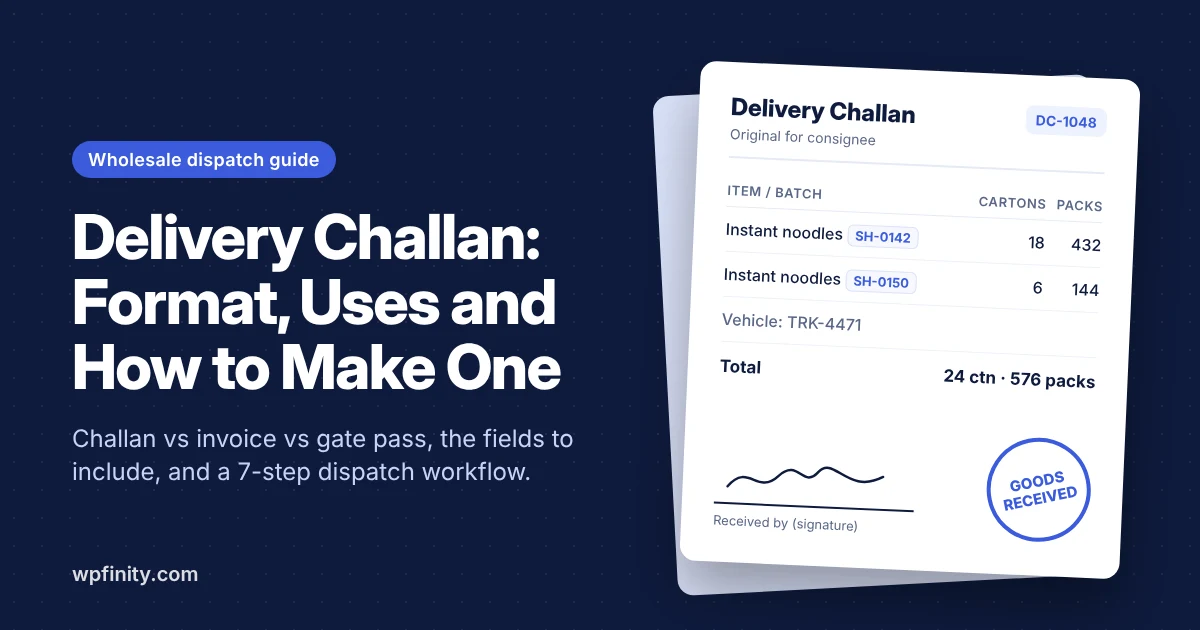
A delivery challan is a document that travels with goods to record what was dispatched, to whom and in what quantity. It is proof of delivery, not a bill: the customer signs it on receipt, and the invoice follows or travels with it. Wholesalers use a delivery challan whenever goods leave the warehouse before billing, move between branches, or go out on sale-or-return.
Below you will find the delivery challan format fields that matter, how a challan differs from an invoice and a gate pass, and a simple workflow for issuing one from each order. If you want challans, invoices and stock to come from one order record, you can try WholeStock free on WordPress.org.
What is a delivery challan?
A delivery challan is a dispatch note listing the goods, quantities and parties in a consignment, signed by the receiver as acknowledgement. It records the physical movement of stock, while the invoice records the money owed.
The word “challan” is common in South Asian trade, but the document exists everywhere. In the US and UK the same paper is usually called a delivery note or packing slip. The idea is identical: one sheet that the driver carries, the customer signs, and you file as proof.
When do wholesalers need a delivery challan?
You need a delivery challan whenever goods move without a final invoice, or when the receiver must sign for what arrived. For a typical distributor that means:
- Credit customers: goods go out today, the invoice is settled over weeks, and the signed challan proves delivery if a dispute about dues comes up.
- Branch and warehouse transfers: stock moves from your main godown to a second branch. Nothing is sold, but the movement needs a record.
- Sale or return: a retailer takes 20 cartons on trial and returns what does not sell.
- Job work: goods sent out for packing, labelling or repair and expected back.
- Unknown final quantity: bulk goods where the exact quantity is confirmed only on delivery.
In India, Rule 55 of the CGST Rules lists the cases where a delivery challan may be issued in place of a tax invoice, including job work, unknown quantity and movement for reasons other than supply (Rule 55 text).
What should a delivery challan format include?
A good delivery challan format identifies the parties, the goods, the quantities in the unit actually shipped, and a signature line. Everything else is optional unless your tax rules require it.
| Field | Why it matters |
|---|---|
| Challan number and date | Lets you match the challan to an order, invoice and stock movement |
| Sender and receiver details | Name, address and phone, plus tax IDs where required |
| Item description and code | Avoids “which oil?” arguments at the customer’s door |
| Quantity and unit | Write “18 cartons (432 packs)”, not just “432” |
| Batch or lot reference | Traces a complaint back to the shipment it came from |
| Vehicle and driver | Needed when the goods pass a gate or checkpoint |
| Receiver’s signature and stamp | Your proof of delivery if dues are disputed |
For GST-registered businesses in India, Rule 55 also requires the HSN code, consignor and consignee GSTIN, place of supply for inter-state moves, a serial number of up to 16 characters, and three copies marked for consignee, transporter and consigner (ClearTax summary). Check your local tax rules before relying on any template.
Delivery challan vs invoice vs gate pass: what’s the difference?
An invoice asks for payment, a delivery challan proves what was delivered, and a gate pass authorizes goods or a vehicle to leave your premises. Most wholesale dispatches need all three, and the mistakes happen when they are written separately by hand.
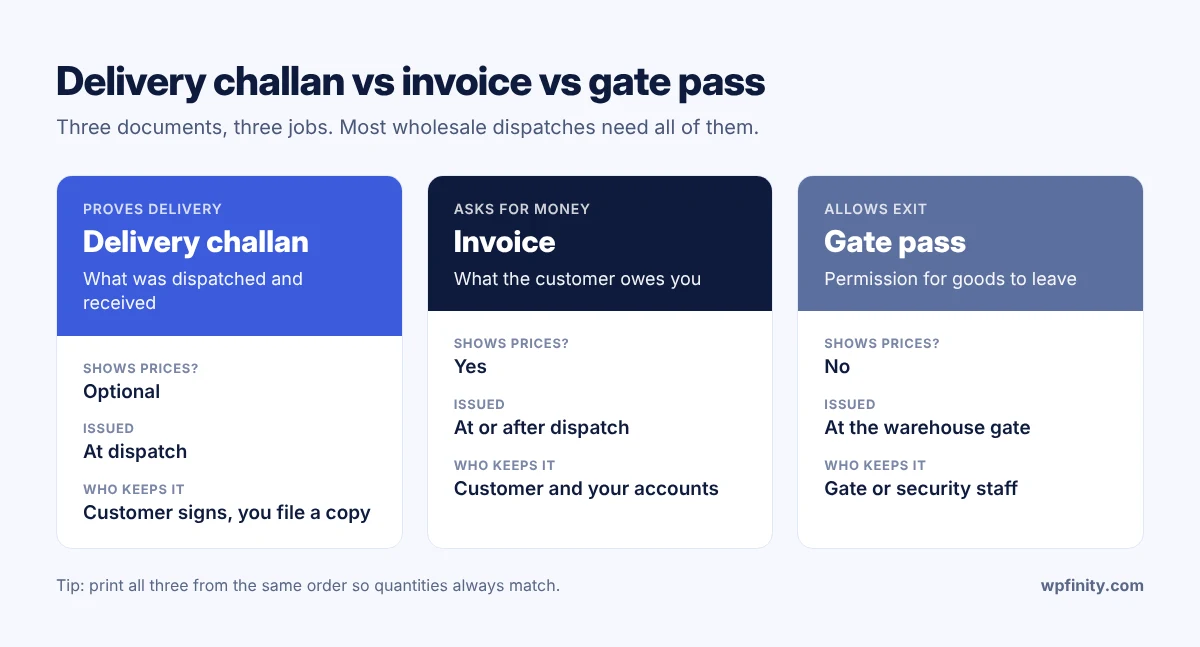
| Delivery challan | Invoice | Gate pass | |
|---|---|---|---|
| Purpose | Proof of what was dispatched and received | Request for payment | Permission to exit the warehouse |
| Shows prices? | Optional | Yes | No |
| Who keeps it | Customer signs; you file a copy | Customer and your accounts | Gate or security staff |
| When issued | At dispatch | At or after dispatch | At the gate |
What does a missing or wrong challan cost a wholesaler?
A missing or wrong delivery challan turns every disagreement into your word against the customer’s. The cost lands in three places:
- Dues you cannot prove: a credit customer says only 15 cartons arrived, not 18. Without a signed challan you either argue or write off the difference.
- Stock that never reconciles: handwritten challans in a book do not reduce stock anywhere. At month end the spreadsheet says 40 cartons, the shelf says 37.
- Wrong batch, wrong cost: if a challan does not say which shipment the goods came from, your profit per batch is a guess.
This is why the challan should come from the same record as the order, the invoice and the stock. We covered the dues side in how to track customer dues in a wholesale business and the stock side in our wholesale inventory management guide.
How do you make a delivery challan, step by step?
Make the delivery challan from a confirmed order, after picking and before the vehicle leaves. Here is the workflow, using a worked example: a customer orders 24 cartons of instant noodles, 24 packs per carton.
- Confirm the order in cartons: 24 cartons = 576 packs.
- Pick from specific batches: 18 cartons from shipment SH-0142, 6 cartons from SH-0150, oldest stock first.
- Print the challan with both batch references, quantities in cartons and packs, and vehicle details.
- Print the gate pass so the guard can check the load against the order without seeing prices.
- Get the challan signed at the customer’s door and file your copy.
- Mark the order delivered and send or print the invoice.
- Record payments as they come: for example, the customer pays the invoice in three parts over a month.
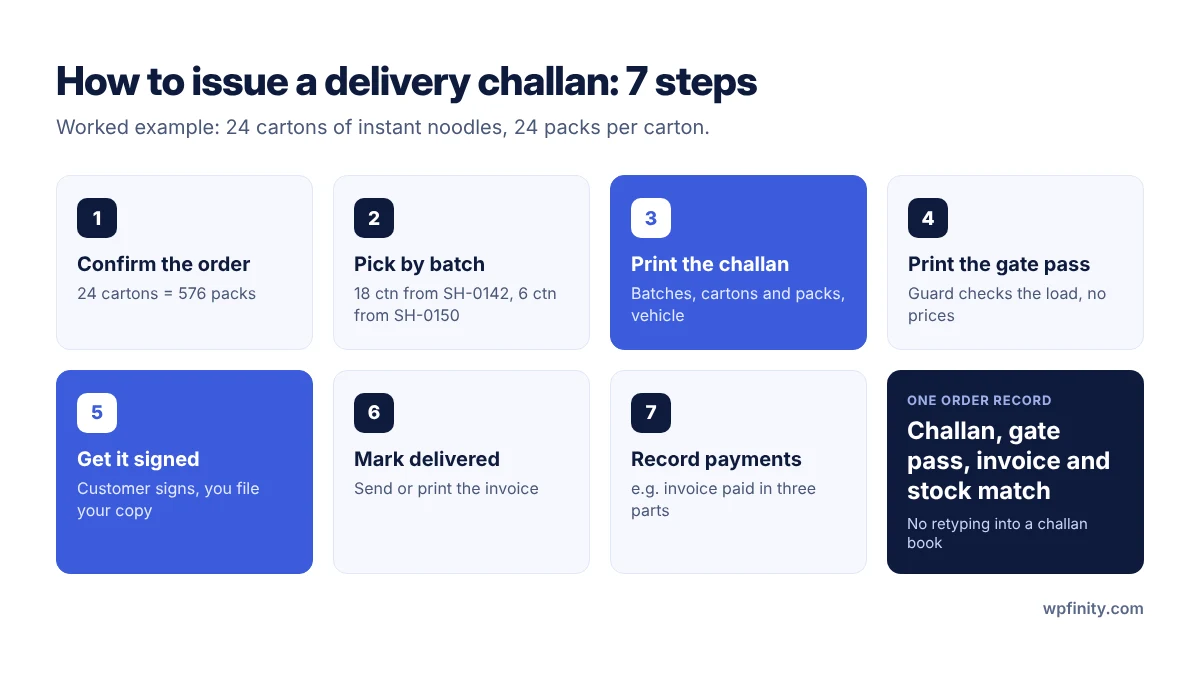
The steps are simple. The hard part is doing all seven without retyping the same order into a challan book, an invoice template and a stock sheet.
Run your orders, stock and invoices in one place
WholeStock is a free WordPress plugin for wholesalers: batch-based orders, carton-to-piece units, customer dues and branded invoices. No WooCommerce needed.
How does WholeStock handle delivery challans in WordPress?
WholeStock keeps the challan, gate pass, invoice and stock movement tied to the same sales order, so you enter the order once. The free plugin runs the order and stock side; WholeStock Pro adds the printable warehouse documents.
Here is the same noodle order in WholeStock:
- Free: record the inbound shipment with supplier, reference and per-unit cost. Each line becomes a traceable batch, and stock reconciles in packs while you sell in cartons.
- Free: create the sales order from batches SH-0142 and SH-0150. Overselling is blocked, so you cannot dispatch 24 cartons if only 20 remain.
- Pro: print a picking list showing quantities in cartons and the shipment and carton each line comes from, with no prices.
- Pro: print the delivery challan and gate pass for the order.
- Free: move the order from confirmed to delivered, print or share a branded PDF invoice, and record partial payments in cash, bank, mobile or check. The customer’s outstanding due updates automatically.
- Pro: print a customer ledger statement with a running balance when you chase the next payment.
A few practical answers to the usual objections:
- No WooCommerce or online store required. WholeStock works standalone on WordPress 6.2+ with PHP 8.0+, on standard hosting.
- Your data stays in your own WordPress database. Customers, prices and stock are not sent to an outside service.
- Staff roles let editors manage orders and stock without seeing cost or profit.
- No per-seat or monthly fees. WholeStock Pro is sold as annual or one-time lifetime licences, starting at $49 a year for one site, with a 14-day money-back guarantee.
If you invoice under GST in India, compare the printed challan with the Rule 55 fields above before you rely on it for tax purposes.
Delivery challan FAQ
Is a delivery challan the same as an invoice?
No. A delivery challan records goods dispatched and received; an invoice requests payment. Many wholesale orders need both, plus a gate pass.
Does a delivery challan need prices?
Not always. Prices are optional on most challans, though under India’s GST Rule 55 a challan used for supply must show taxable value and tax details.
How many copies of a delivery challan should I make?
Make at least two: one for the customer and one signed copy for your file. Under India’s GST rules, three copies are required for supply of goods.
What is the difference between a delivery challan and a gate pass?
A gate pass lets goods or a vehicle leave your premises. A delivery challan travels to the customer and is signed as proof of receipt.
Can WholeStock print delivery challans?
Yes. WholeStock Pro prints delivery challans, gate passes and picking lists from sales orders. The free WholeStock plugin handles orders, batches, invoices and dues.
Do I need WooCommerce to use WholeStock?
No. WholeStock is a standalone WordPress plugin. It needs WordPress 6.2+ and PHP 8.0+ and stores data in your own database.
Print challans, gate passes and picking lists from every order
WholeStock Pro adds warehouse documents, customer ledgers, CSV exports and analytics. Annual or one-time lifetime licences, no per-seat fees, 14-day money-back guarantee.

 Wholesale & Inventory
November 3, 2026
Self-Hosted Inventory Software vs SaaS for Wholesalers
Self-hosted inventory software vs SaaS for wholesalers: real 3-year costs, data ownership, when SaaS still wins, and how WholeStock works.
Read more
 Wholesale & Inventory
October 26, 2026
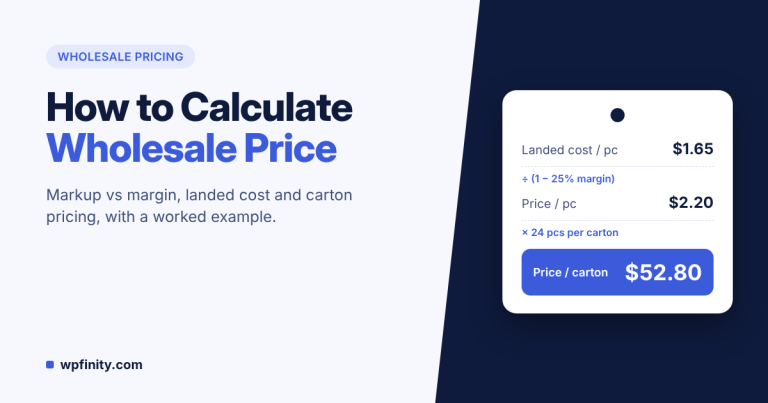
How to Calculate Wholesale Price: Markup vs Margin
Calculate wholesale price the right way: landed cost, margin vs markup, carton pricing, discounts and credit terms, with a worked…
Read more
 Wholesale & Inventory
October 23, 2026
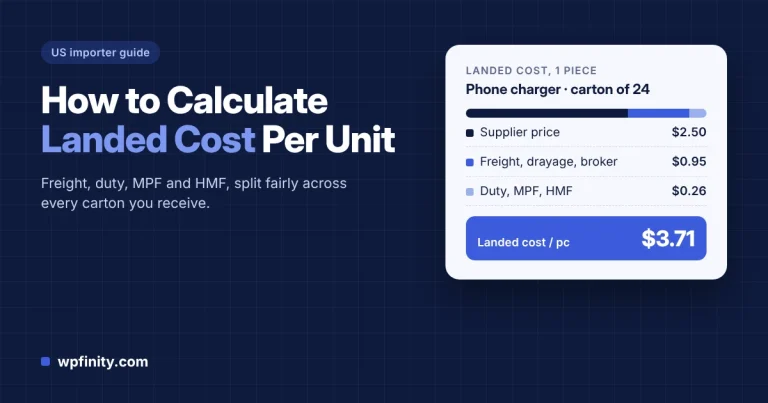
How to Calculate Landed Cost Per Unit for US Importers
Learn how to calculate landed cost per unit for imported wholesale goods, with a worked US example covering freight, duty,…
Read more
Get new articles & release notes in your inbox
Sign up for updates on our upcoming releases. No spam — unsubscribe anytime.