
How to Calculate Landed Cost Per Unit for US Importers
Learn how to calculate landed cost per unit for imported wholesale goods, with a worked US example covering freight, duty, MPF and HMF.

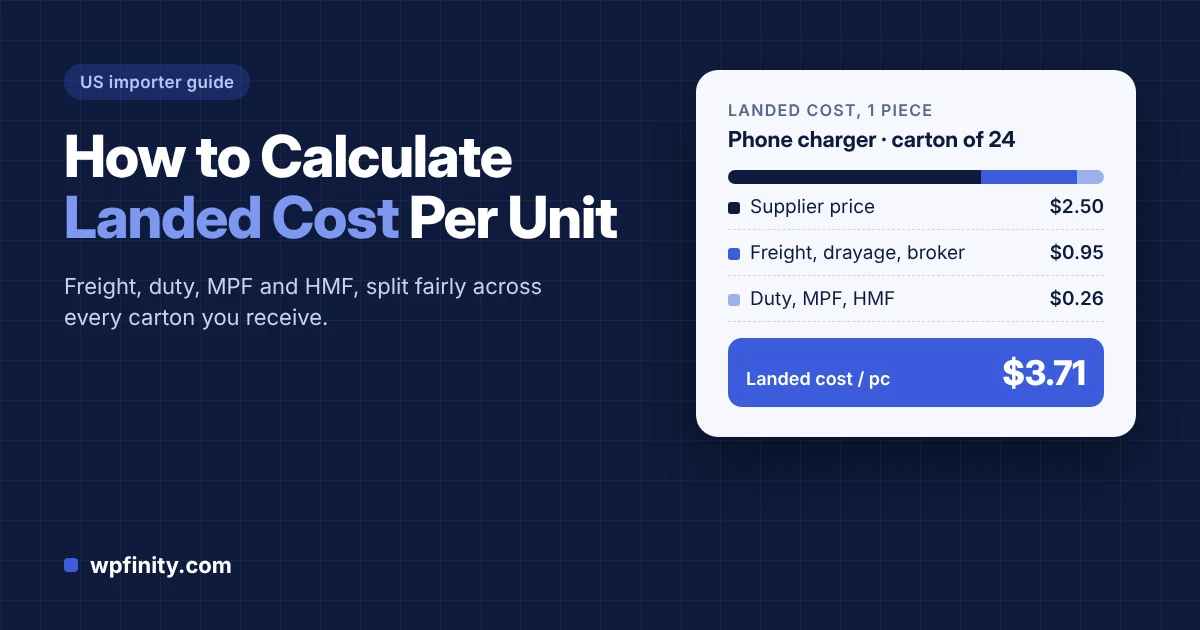
Landed cost per unit is what one unit really costs you once it sits on your warehouse shelf: the supplier price plus freight, duties, customs fees, brokerage and inland trucking, divided by the units received. To calculate landed cost, total every cost of the shipment, allocate shared costs to each product by value or by cartons, then divide by pieces. Skip it and you price from the supplier invoice, which in the example below overstates margin by almost 29 points.
If you’d rather have this done automatically for every shipment, you can try WholeStock free on WordPress.org. The method below works with or without it.
What is landed cost per unit?
Landed cost per unit is the total cost of getting a product from your supplier into your warehouse, divided by the number of sellable units in that shipment. It is the number your selling price and margin should be based on, not the supplier’s unit price.
For a US importer, a shipment’s landed cost usually includes:
- Product cost: the supplier invoice value, such as the FOB price
- Freight: ocean or air freight, plus origin and destination port charges
- Duties: set by the product’s HTS classification and country of origin
- Customs fees: the Merchandise Processing Fee (MPF) and, for ocean cargo, the Harbor Maintenance Fee (HMF)
- Customs broker fee and drayage (trucking from the port to your warehouse)
- Cargo insurance, if you buy it
Why does the supplier price give you the wrong margin?
The supplier invoice ignores every dollar spent after goods leave the factory, so margins look healthy on paper while the bank account disagrees. The gap is widest on cheap, bulky goods, where freight is large compared with product value.
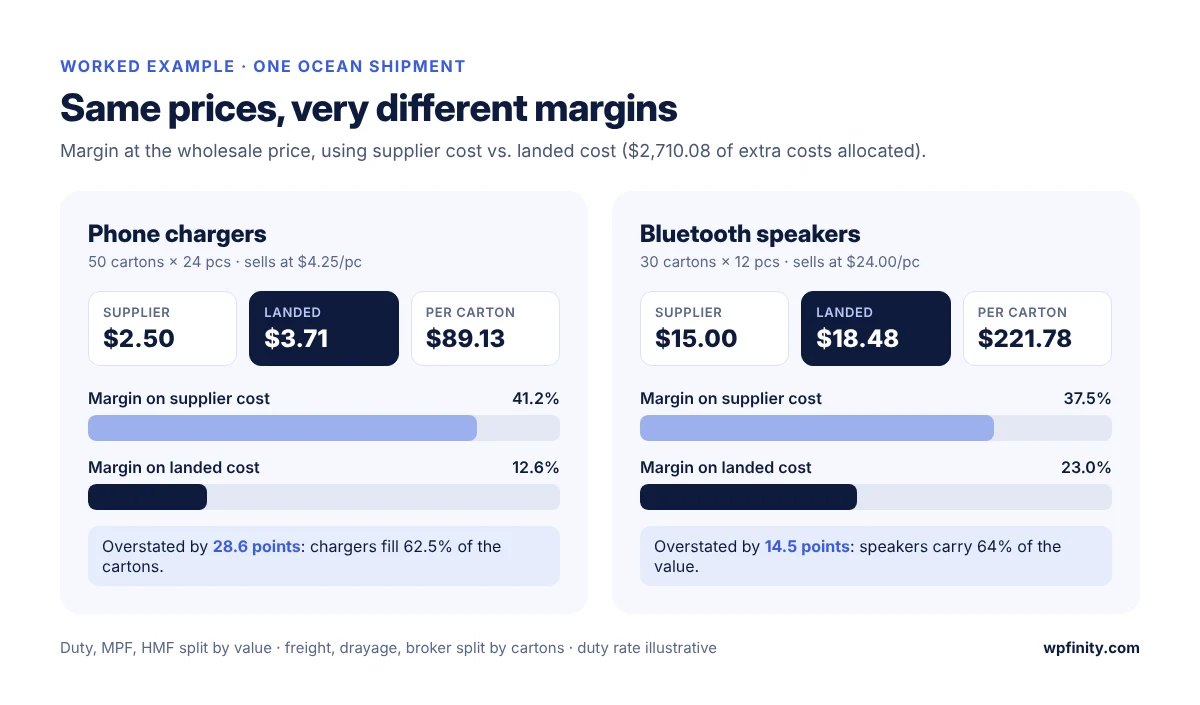
Take a phone charger that costs $2.50 from the supplier and sells for $4.25 wholesale. On the supplier price, the margin looks like 41%. On its real landed cost of $3.71, it is 12.6%. If that customer also buys on 60-day credit, a thin margin gets thinner while you wait to be paid.
The usual damage looks like this:
- Quotes priced too low that you can’t easily raise later
- “Best-selling” items that barely break even once freight and duty are counted
- Old and new shipments averaged together, so a freight spike hides inside your stock value
How to calculate landed cost: the formula and 6 steps
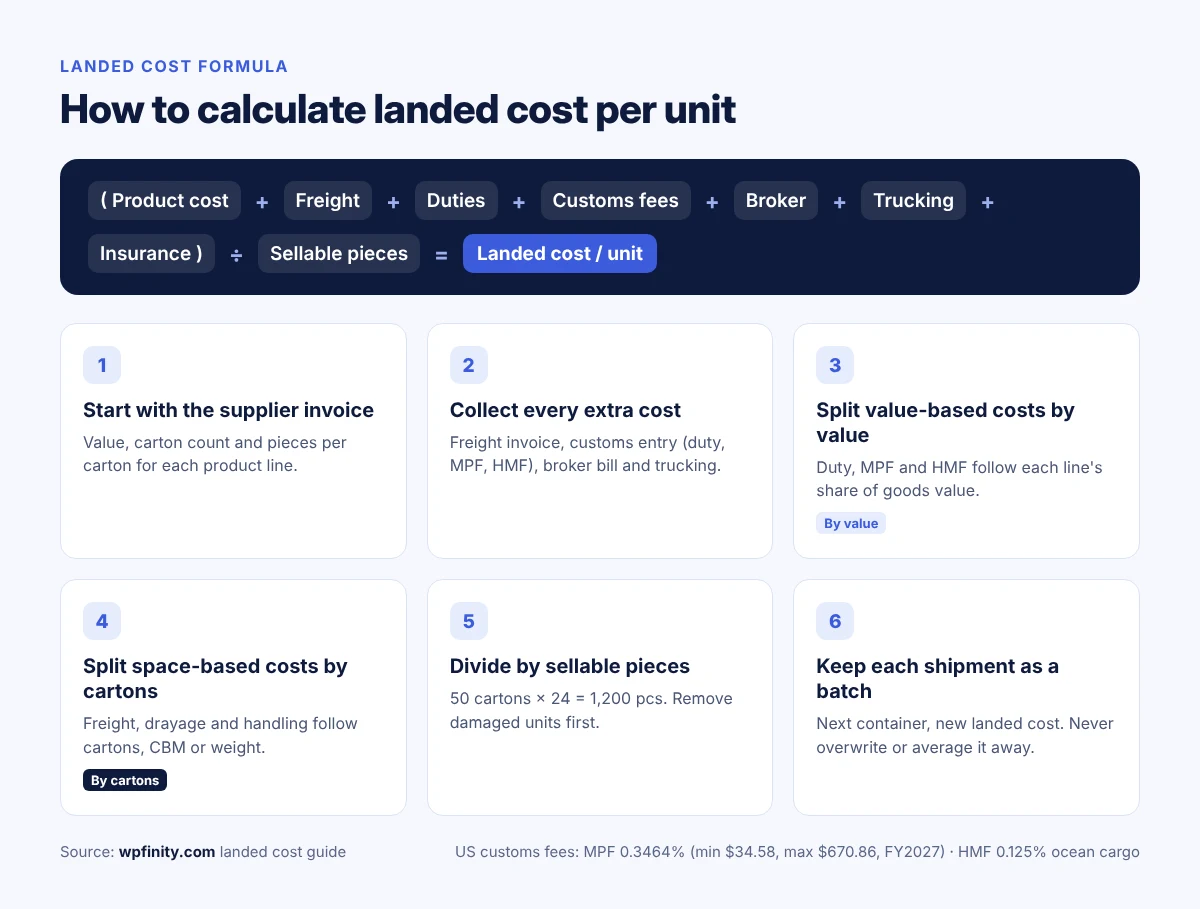
The landed cost formula is: (product cost + freight + duties + customs fees + brokerage + inland delivery + insurance) ÷ sellable units received. The hard part is splitting shared costs fairly when one container holds several products.
- Start with the supplier invoice. Note the value, carton count and pieces per carton for each product line.
- Collect every extra cost for the shipment: freight invoice, customs entry (duty, MPF, HMF), broker invoice and trucking bill.
- Split value-based costs by value. Duty, MPF and HMF are calculated on the goods’ value, so allocate them in proportion to each line’s value.
- Split space-based costs by cartons, volume or weight. Freight, drayage and handling depend on how much room goods take, so allocate them by cartons (or by CBM or weight if carton sizes differ a lot).
- Divide by sellable pieces, not cartons. Convert to the unit you sell in (50 cartons × 24 = 1,200 pieces), remove damaged units, then divide.
- Keep each shipment as its own batch. Next month’s container will carry different freight and duty, so its landed cost will differ. Don’t overwrite the old number.
Which US customs fees go into landed cost?
For formal entries, CBP’s Merchandise Processing Fee is 0.3464% of entered value, with a minimum of $34.58 and a maximum of $670.86 for fiscal year 2027, effective October 1, 2026 (Livingston International). Ocean imports also pay the Harbor Maintenance Fee of 0.125% of cargo value, with no minimum or maximum (Ginger Control). Duty rates come from the Harmonized Tariff Schedule, and because tariffs have changed often, confirm the current rate with your broker for every shipment.
What does landed cost look like on a real shipment?
Worked example: an electronics accessories wholesaler receives one ocean shipment with two products.
- Phone chargers: 50 cartons × 24 pcs = 1,200 pcs at $2.50 = $3,000
- Bluetooth speakers: 30 cartons × 12 pcs = 360 pcs at $15.00 = $5,400
The shipment’s extra costs, and how each one is split:
| Extra cost | Amount | Allocated by |
|---|---|---|
| Ocean freight and port charges | $1,200.00 | Cartons |
| Drayage to warehouse | $450.00 | Cartons |
| Customs broker | $175.00 | Cartons |
| Duty (illustrative 10%) | $840.00 | Value |
| MPF (minimum applies) | $34.58 | Value |
| HMF (0.125%) | $10.50 | Value |
| Total extra costs | $2,710.08 |
The MPF line is one many spreadsheets miss: 0.3464% of $8,400 is only $29.10, but CBP charges the $34.58 minimum.
Chargers take 62.5% of the cartons but only 36% of the value, so they carry more of the freight. The result:
| Product | Supplier cost/pc | Landed cost/pc | Landed cost/carton | Price/pc | Margin on supplier cost | Margin on landed cost |
|---|---|---|---|---|---|---|
| Chargers | $2.50 | $3.71 | $89.13 | $4.25 | 41.2% | 12.6% |
| Speakers | $15.00 | $18.48 | $221.78 | $24.00 | 37.5% | 23.0% |
If you allocated everything by value instead, chargers would show $3.31 a piece and speakers $19.84. You would underprice the bulky item and overprice the compact one.
Spreadsheet or inventory software: which is better for landed cost?
A spreadsheet can calculate landed cost for one shipment, but struggles to keep that cost attached to stock as it sells over weeks. Software that ties landed cost to each batch keeps profit accurate without month-end reconciliation.
| Task | Spreadsheet | WholeStock |
|---|---|---|
| Add shipment extra costs | Manual formulas each time | Included in each item’s landed unit cost |
| Cartons to pieces | Manual math | Automatic unit conversions |
| Keep cost per shipment | Easy to overwrite or average | Each shipment line becomes its own batch |
| Profit per shipment | Lookups across tabs | Cost, revenue and P/L per batch |
| Hide costs from staff | Separate files | Editor-level staff can’t see costs or profit |
Stop pricing from the supplier invoice
WholeStock is free on WordPress.org. Record a shipment, add its freight and customs costs, and see the landed cost of every batch, with no WooCommerce and no monthly fees.
How does WholeStock calculate landed cost in WordPress?
WholeStock, a wholesale inventory plugin for WordPress, includes a shipment’s extra costs in each item’s landed unit cost, so every batch carries its true cost from receiving to sale. Here is how the shipment above runs through it:
- Set units once. Chargers: 1 carton = 24 pcs. Speakers: 1 carton = 12 pcs.
- Record the inbound shipment with supplier, arrival date and BL reference number, then add both lines in cartons with the supplier’s per-unit cost.
- Add the shipment’s extra costs (freight, customs, duty, handling). WholeStock includes them in the landed unit cost of each item.
- Sell from the batch. Each sales order draws from that shipment’s batch, overselling is blocked, and customers can pay in full or in parts.
- Check batch profit and loss. The stock view shows cost, revenue and P/L per batch, and flags batches older than 60 days as dead stock.
WholeStock Pro lets you itemize shipment costs (sea freight, customs duty, insurance and more), choose how they are allocated across line items, and see revenue, margin and cash-flow charts.
Common questions before switching:
- No WooCommerce needed. WholeStock runs on its own inside WordPress.
- Your data stays yours. Everything is stored in your own WordPress database.
- Standard hosting works. It needs WordPress 6.2+ and PHP 8.0+.
- No per-seat or monthly fees. Pro starts at $49/year or $149 lifetime for one site, with a 14-day money-back guarantee.
For the bigger picture, read our wholesale inventory management guide and how to track customer dues so better margins turn into collected cash.
Frequently asked questions
What is included in landed cost?
Landed cost includes the supplier price, freight, duties, customs fees (MPF and, for ocean cargo, HMF in the US), customs broker fees, inland trucking and insurance. Warehouse rent and selling costs usually go into overhead instead.
What is the difference between landed cost and COGS?
Landed cost is what your inventory costs to get into the warehouse. Cost of goods sold (COGS) is the landed cost of the units you actually sold in a period, so accurate landed cost makes COGS accurate.
Should I allocate freight by value or by volume?
Allocate value-based charges such as duty, MPF and HMF by value, and space-based charges such as freight and trucking by cartons, volume or weight. Allocating everything by value undercosts cheap, bulky items.
Is the Merchandise Processing Fee always 0.3464%?
For formal entries the MPF is 0.3464% of entered value, but for fiscal year 2027 it is never less than $34.58 or more than $670.86. Small shipments often pay the minimum.
Can I average landed cost across shipments?
You can, but averaging hides cost swings between containers. Keeping each shipment as a separate batch shows which shipment actually made money and which one did not.
Does WholeStock need WooCommerce?
No. WholeStock is a standalone WordPress plugin. The free core is on WordPress.org, and WholeStock Pro is an optional paid add-on.
Know the real cost of every carton
Install WholeStock free, run your next shipment through it, and see landed cost and profit for every batch. Upgrade to Pro only when you want the analytics.

 Wholesale & Inventory
November 3, 2026
Self-Hosted Inventory Software vs SaaS for Wholesalers
Self-hosted inventory software vs SaaS for wholesalers: real 3-year costs, data ownership, when SaaS still wins, and how WholeStock works.
Read more
 Wholesale & Inventory
November 1, 2026
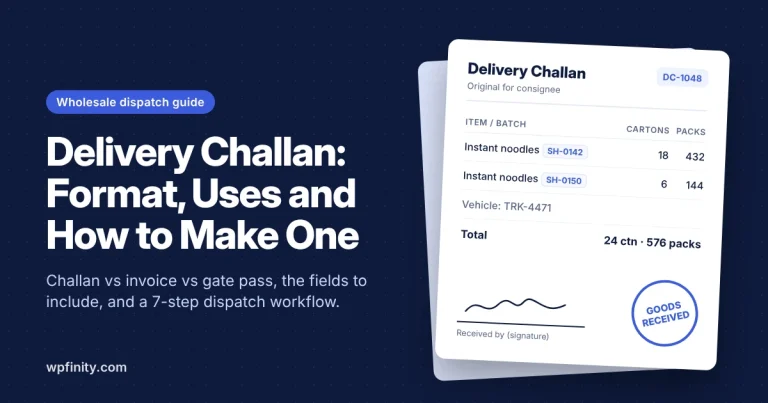
Delivery Challan: Format, Uses and How to Make One
What a delivery challan is, what to include, how it differs from an invoice and gate pass, and how wholesalers…
Read more
 Wholesale & Inventory
October 26, 2026
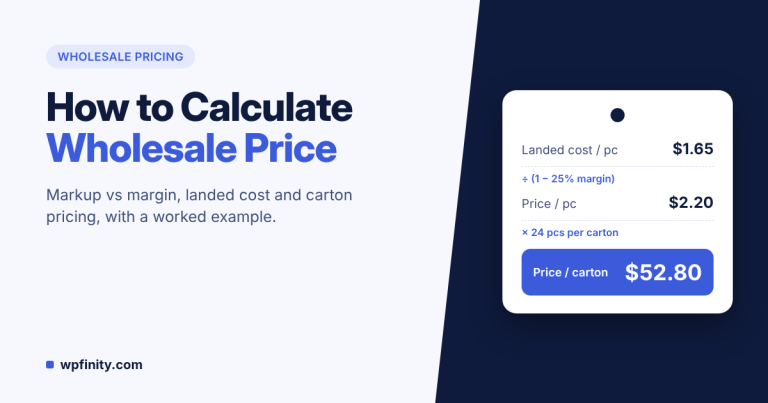
How to Calculate Wholesale Price: Markup vs Margin
Calculate wholesale price the right way: landed cost, margin vs markup, carton pricing, discounts and credit terms, with a worked…
Read more
Get new articles & release notes in your inbox
Sign up for updates on our upcoming releases. No spam — unsubscribe anytime.


One Response