
Cleaning Business Cancellation Policy: How to Write One (With Template)
Write a cleaning business cancellation policy that cuts no-shows: notice windows, lockout fees, deposits, a copy-ready template and how to enforce it.

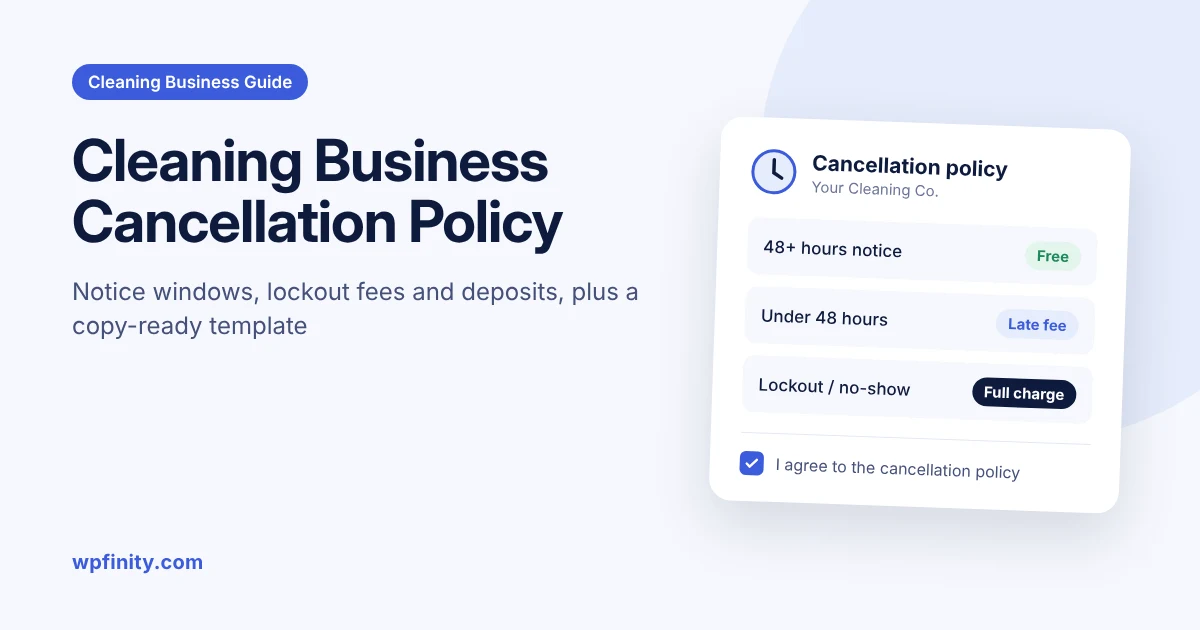
Short answer: A cleaning business cancellation policy is a short set of rules that tells clients how much notice they must give to cancel or reschedule, what happens if they cancel late or lock your crew out, and how any fee is charged. The policies that work best use a 24–48 hour notice window, a clear late-cancellation fee, a lockout fee, and a card or deposit collected at booking so the rule is enforced automatically.
A crew drives 30 minutes, the gate code doesn’t work, and nobody answers the phone: that slot is gone. A written cleaning business cancellation policy won’t stop every no-show, but it changes client behavior and protects your crew’s paid hours. This guide covers what to include, how much to charge, whether to take deposits, a copy-ready template, and how to enforce it through your online booking form.
What is a cleaning business cancellation policy?
A cleaning business cancellation policy is the part of your service terms that defines the notice clients must give to cancel or move a booking, and the fees that apply when they don’t. It usually covers late cancellations, no-shows, lockouts (your team can’t get in), and rescheduling.
For specialty work such as pressure washing, carpet cleaning or junk removal, the policy also needs to cover weather and the crew and equipment you commit in advance.
Why does a cleaning business need a cancellation policy?
Because a cancelled cleaning slot is revenue you can rarely recover: your crew’s time, fuel and planning are already spent. A clear policy plus reminders reduces how often it happens, and a fee recovers part of the cost when it does.
The research on appointments points the same way. A Cochrane systematic review of text-message reminders (7 studies, 5,841 participants) found attendance of 78.6% with SMS reminders versus 67.8% without. A 2011 review by Hasvold and Wootton found automated SMS or phone reminders cut hospital non-attendance by a weighted average of 29%, as summarized in SchedulingKit’s no-show statistics roundup. That same roundup reports salons and barbershops, which commonly use booking deposits and card-on-file policies, at just 3–4% no-shows in Zenoti’s 2025 benchmark.
Those numbers come from healthcare and beauty, not cleaning, but the lesson carries over: clients keep appointments they’ve been reminded about and have something at stake in. A policy gives you three things:
- Fewer late cancellations, because clients see the rule before they book.
- Recovered revenue for the slots that still get lost, from a fee or a kept deposit.
- Less awkwardness: you’re applying a published rule, not negotiating a penalty on the phone.
What should a cleaning business cancellation policy include?
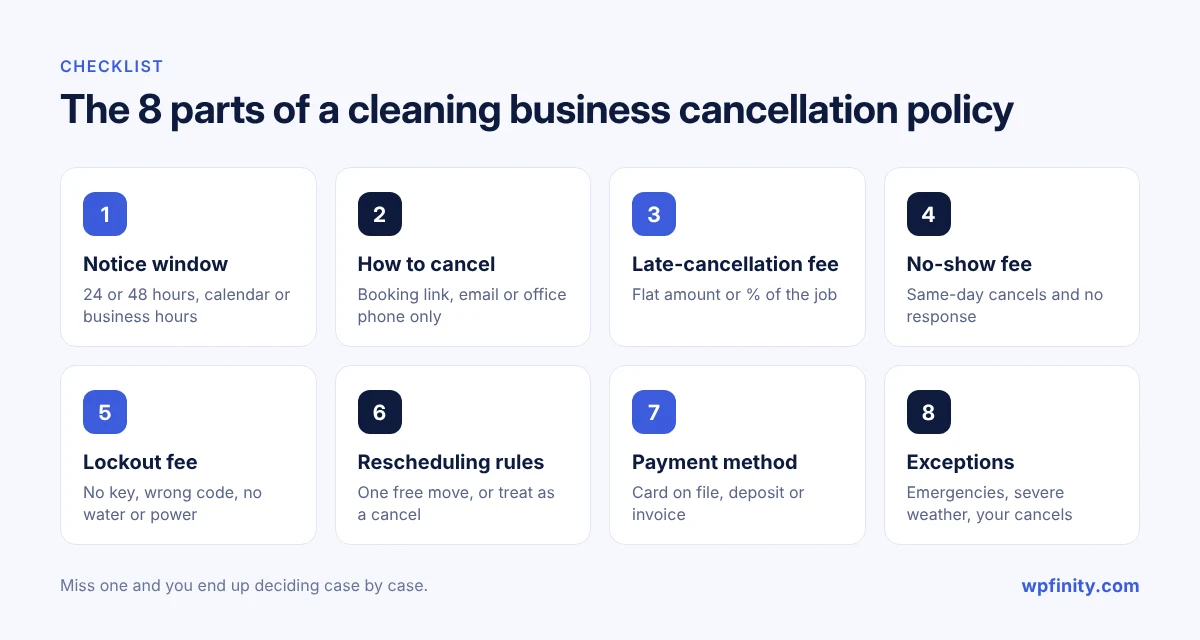
A complete cleaning business cancellation policy includes eight parts: the notice window, how to cancel, the late-cancellation fee, the no-show fee, the lockout fee, rescheduling rules, how payment is taken, and your exceptions. Leave any of these out and you’ll end up deciding case by case, which is where disputes start.
- Notice window. How many hours before the appointment a client can cancel for free. Most cleaning companies use 24 or 48 hours. State whether that means calendar hours or business hours.
- How to cancel. Which channels count: your online booking page, email, or a phone call to the office. A text to an individual cleaner should not count.
- Late-cancellation fee. What you charge when notice is shorter than the window, as a flat amount or a percentage of the job.
- No-show fee. What you charge when the client cancels on the day or doesn’t respond at all.
- Lockout fee. What applies if your crew arrives and can’t get in: no key, wrong code, pets loose, no access to water or power for pressure washing.
- Rescheduling rules. Whether a reschedule inside the window is free once, or treated like a cancellation.
- Payment method. Whether you keep a card on file, take a deposit at booking, or invoice the fee afterwards.
- Exceptions. How you handle emergencies, severe weather and your own cancellations, so the policy is fair both ways.
Here’s the same checklist as a one-page graphic you can keep next to your booking settings:
How much should you charge for a late cancellation or lockout?
Most cleaning businesses charge between a flat fee and the full job price, scaled by how late the notice is. Bigger, crew-heavy jobs justify longer windows and higher fees because they are harder to refill.
The table below shows a practical starting point by service type. These are example ranges, not industry benchmarks; adapt them to your market and cancellation history.
| Service type | Suggested notice window | Late cancellation | No-show / lockout |
|---|---|---|---|
| Standard residential (recurring) | 24 hours | Flat fee or 25–50% of visit | 50–100% of visit |
| Deep cleaning / move-in, move-out | 48 hours | 50% of quoted price | Up to 100% or keep deposit |
| Office / commercial | 24–48 hours (set in contract) | Per contract terms | Full visit charge |
| Window, carpet, pressure washing | 48 hours (weather exception) | Flat trip fee | Trip fee + % of job |
| Junk removal / hauling | 24–48 hours | Flat trip fee | Trip fee or keep deposit |
A tiered structure keeps it fair: the later the notice, the higher the fee. This is the tiered approach in one picture:
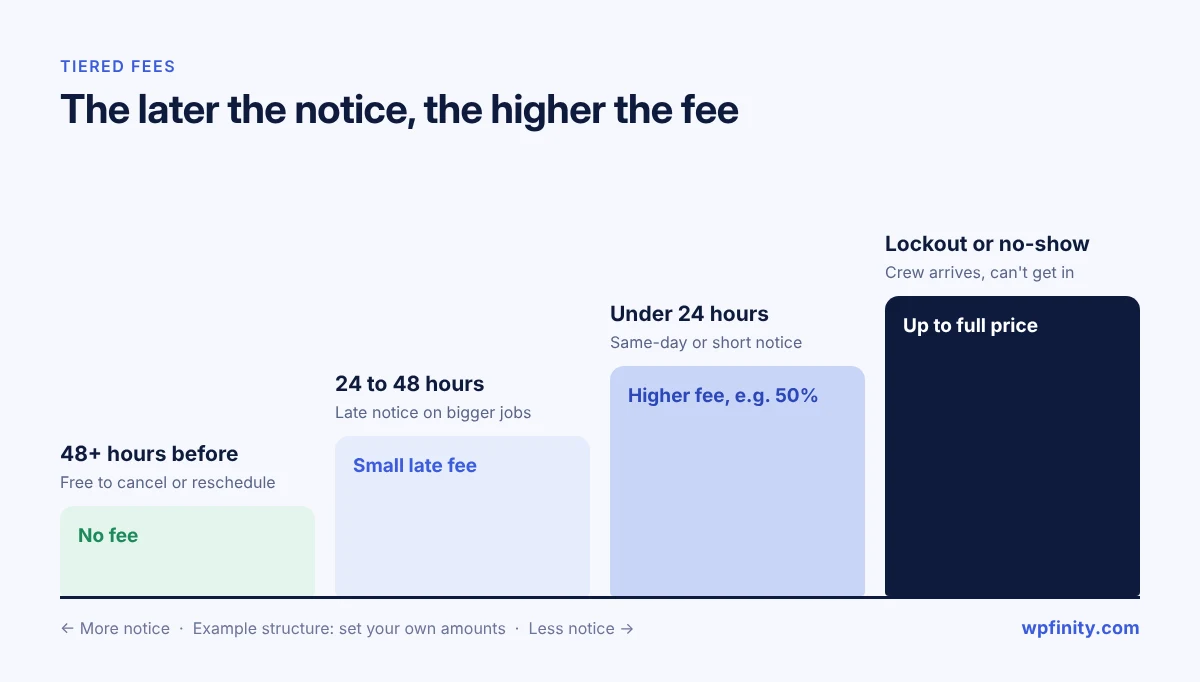
Two tips from working with service businesses: first, keep the fee lower for loyal recurring clients and offer one free late reschedule a year; it costs little and buys a lot of goodwill. Second, always charge the lockout fee consistently. Lockouts are the most preventable loss, and clients start leaving keys and codes reliably once they know the rule is real.
Get early access to Cleannetic
Join the Cleannetic early-access list for an invite to try the plugin before it launches, plus practical booking tips for cleaning businesses.
Should you take a deposit for cleaning jobs?
Take a deposit for large one-off jobs such as deep cleans, move-out cleans and specialty work; for recurring residential clients a card on file is usually enough. A deposit means the client has already paid something, which is the strongest no-show deterrent you have.
| Option | How it works | Best for | Watch out for |
|---|---|---|---|
| Deposit at booking | Client pays a fixed amount or % upfront; it comes off the final bill | Deep cleans, move-in/out, pressure washing, junk removal | Explain clearly when it is refundable |
| Card on file | Card saved at booking, charged only after the job or for a fee | Recurring residential and small offices | Clients must agree to the policy at checkout |
| Full prepayment | Client pays the whole price when booking | Fixed-price packages, first-time clients | Higher drop-off on the booking form |
| Invoice the fee later | You email an invoice after a late cancellation | Commercial contracts with terms | Many fees never get paid |
If you’re new to online payments, start with card-on-file for recurring clients and a 20–30% deposit for one-off jobs over a certain value. Our online booking setup guide for cleaning businesses walks through where deposits fit in the booking flow.
Cleaning service cancellation policy template
Copy the template below, replace the bracketed parts with your own numbers, and publish it on your booking page, your terms page and your confirmation emails. This is a starting point, not legal advice; check consumer-protection rules in your state or country before you charge fees.
Cancellation & Rescheduling Policy for [Your Company Name]
We reserve time, staff and equipment for every booking. To keep our schedule fair for every client, we ask for at least [24/48] hours’ notice to cancel or reschedule.
How to cancel: Use the link in your booking confirmation, email [email], or call [phone]. Messages sent to individual team members don’t count as notice.
Late cancellation: Cancelling with less than [24/48] hours’ notice incurs a fee of [$X / X% of the booking].
No-shows and lockouts: If we arrive and can’t access the property (no one home, no key, incorrect code, or no access to water or power where needed), the full price of the visit will be charged.
Deposits: One-off jobs over [$X] require a [X%] deposit at booking. Deposits are refundable with [24/48] hours’ notice and are applied to your final bill.
Rescheduling: You can reschedule once free of charge with [24/48] hours’ notice.
Exceptions: We waive fees for genuine emergencies and severe weather. If we ever need to cancel, you’ll get as much notice as possible and priority rebooking.
By booking with us, you agree to this policy.
How do you enforce a cancellation policy without losing customers?
Enforce it by making the policy visible before booking, automating reminders and charges, and applying it the same way every time. Clients rarely argue with a rule they agreed to at checkout; they argue with a surprise.
- Show the policy on the booking form, next to the price, with a required checkbox: “I agree to the cancellation policy.”
- Repeat it in the confirmation email and in every reminder, with a one-click cancel or reschedule link.
- Send reminders 48 hours and 24 hours before the visit, so clients cancel inside the free window instead of on the day.
- Collect payment details upfront, either a card on file or a deposit, so you never have to chase a fee.
- Apply it consistently. Waive a fee once if you choose to, but say so: “We’ve waived it this time; next time the fee applies.”
- Track repeat cancellers. If someone cancels late three times in 90 days, move them to deposit-only booking.
How can online booking on WordPress enforce your cancellation policy?
A WordPress booking plugin built for cleaning companies can show your policy at checkout, collect a deposit or card, send reminders and give clients a self-service cancel link, so the rules apply automatically.
Online booking for cleaning companies is the problem we’re building Cleannetic to solve. Cleannetic is an upcoming WordPress booking plugin by Wpfinity, made for cleaning companies, with a free version on WordPress.org and a Pro version. It’s designed for the service types cleaning businesses actually sell: residential and deep cleaning, move-in/out, office, window, pressure washing, carpet, junk removal, and custom service types you define yourself.
If you haven’t set up online booking yet, start with our guide to online booking for cleaning businesses, then add the policy above to your booking flow. You can also browse other WordPress plugins by Wpfinity.
A note for WordPress agencies
If you build websites for cleaning companies, put the cancellation policy into scope from day one: a terms page, a checkbox on the booking form and policy text in the confirmation email template. It saves your client awkward calls later.
Cleaning business cancellation policy FAQ
How much notice should a cleaning business require for cancellations?
Most cleaning businesses require 24 hours’ notice for standard residential visits and 48 hours for deep cleans, move-out cleans and specialty jobs like pressure washing or carpet cleaning. Longer, crew-heavy jobs need more notice because they are harder to refill.
What is a lockout fee for a cleaning service?
A lockout fee is charged when your team arrives on time but can’t get into the property, for example no one is home, the key is missing or the gate code is wrong. Many cleaning companies charge the full visit price because the slot is lost either way.
Is it legal to charge a cancellation fee for cleaning services?
In most places you can charge a cancellation fee if the client agreed to it clearly before booking. Rules vary by state and country, so check your local consumer-protection law and keep a record that the client accepted the policy. This article is not legal advice.
Should cleaning companies take a deposit?
Deposits work best for large one-off jobs such as deep cleans, move-in/out cleans, pressure washing and junk removal. For recurring residential clients, a card on file charged after each visit is usually enough and keeps booking friction low.
Can a WordPress booking plugin enforce my cancellation policy?
Yes. A WordPress booking plugin can show the policy at checkout with a required checkbox, collect a deposit or card, send reminders and offer a self-service cancel link. Cleannetic, Wpfinity’s upcoming booking plugin for cleaning companies, is launching soon.
Be first to try Cleannetic
Cleannetic, the WordPress booking plugin for cleaning companies, is launching soon. Join the waitlist to get early access and be the first to know when it goes live.

 Cleaning Business
November 12, 2026
How to Bid Commercial Cleaning Jobs: A Step-by-Step Guide
Learn how to bid commercial cleaning jobs step by step: walkthrough, production rates, labor, overhead and profit, plus a worked…
Read more
 Cleaning Business
November 10, 2026
How to Price Carpet Cleaning: Per Room vs Per Square Foot
Learn how to price carpet cleaning per room or per square foot, with 2026 US price benchmarks, job minimums and…
Read more
 Cleaning Business
October 29, 2026
Cleaning Service Deposits: How Much to Charge and When
Should your cleaning business take a deposit? See how much to charge by service type, deposit vs card on file,…
Read more
Get new articles & release notes in your inbox
Sign up for updates on our upcoming releases. No spam — unsubscribe anytime.

3 Responses