
How to Price Cleaning Services: Hourly vs Flat Rate
How to price cleaning services: hourly vs flat rate vs per sq ft, a simple pricing formula with an example, specialty services and online prices.

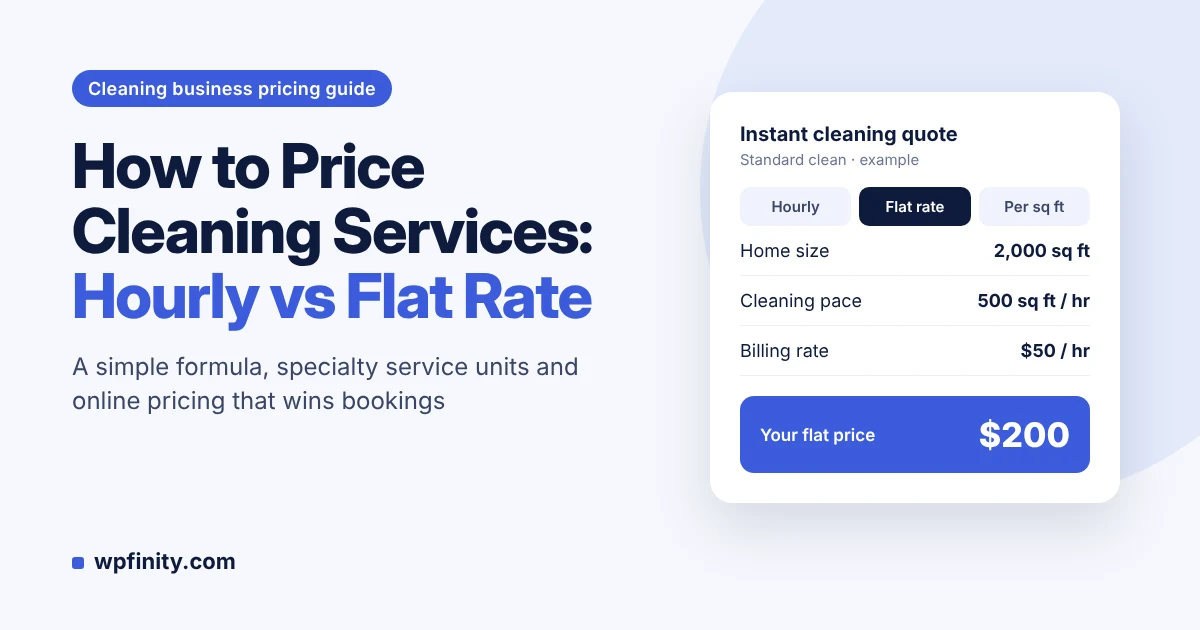
Short answer: To price cleaning services, work out your true cost per labor hour, add a profit margin to get a billable hourly rate, then turn that rate into flat prices using how fast your team actually cleans (square feet per hour or rooms per hour). Most residential cleaning businesses quote flat rates to customers but build them from an hourly number behind the scenes.
This guide walks through how to price cleaning services step by step: hourly vs flat rate vs per square foot, a simple pricing formula with a worked example, pricing units for specialty services like windows, carpet and pressure washing, and how to show prices on your website so visitors book instead of bouncing.
What are the main ways to price cleaning services?
Cleaning businesses use six common pricing models: hourly, flat rate, per square foot, per room or bedroom, per unit (per window, per carpet room) and custom quotes. Most companies mix two of them, for example a flat rate for standard cleans and a custom quote for post-construction jobs.
| Pricing model | How it works | Best for | Watch out for |
|---|---|---|---|
| Hourly | Rate per cleaner per hour | Unclear scope, first-time cleans, organizing | Customers can’t predict the bill; fast teams earn less |
| Flat rate | One price per job or package | Recurring residential cleans | Underpricing if you skip a walkthrough or intake questions |
| Per square foot | Rate x home or office size | Larger homes, offices, move-out cleans | Size alone misses clutter, pets and condition |
| Per bedroom/bathroom | Price set by room count | Online booking forms, standard home cleans | Big rooms and small rooms cost the same |
| Per unit | Price per window, pane, room of carpet or item | Window, carpet, upholstery, junk removal | Needs a minimum charge to cover travel |
| Custom quote | Priced after a site visit or photos | Commercial, post-construction, hoarding, large jobs | Slow; leads go cold while they wait |
For reference, US house cleaners typically charge $30–$80 per hour per cleaner, and $0.10–$0.30 per square foot, according to Housecall Pro’s 2026 house cleaning price guide. Taskrabbit’s house cleaning cost guide lists a national average starting at $33 per hour, with city averages from $41 in Denver to $55 in Boston and Washington, DC (October 2026). Treat these as market context, not as your price.
Hourly vs flat rate: which pricing is better for a cleaning business?
Flat-rate pricing is usually better for residential cleaning businesses because customers book faster when they know the total up front, and an efficient team keeps the time it saves as profit. Hourly pricing still makes sense for jobs where you can’t predict the scope.
Here is how the two compare in day-to-day operations:
- Customer trust: A flat rate answers “how much will it cost?” before the customer has to call you. Hourly pricing leaves them guessing.
- Your margin: With hourly pricing, getting faster lowers your revenue. With flat rates, faster crews earn more per hour.
- Risk: Flat rates put the risk of a slow, messy job on you. Protect yourself with intake questions (pets, condition, last professional clean) and a clear policy for extra time.
- Online booking: Flat rates and room-based prices work well on a booking form. Hourly pricing usually turns into “request a quote”, which adds back-and-forth.
A practical middle ground: quote flat rates for standard, deep and move-out cleans, and keep an hourly rate for add-on time and unusual jobs. Write the extra-time rule into your terms, the same way you would write a cleaning business cancellation policy.
How to price cleaning services step by step
The reliable way to price cleaning services is to start from costs, not from competitors: calculate your cost per labor hour, add your margin to get a billing rate, then convert it into flat prices using your real cleaning pace.
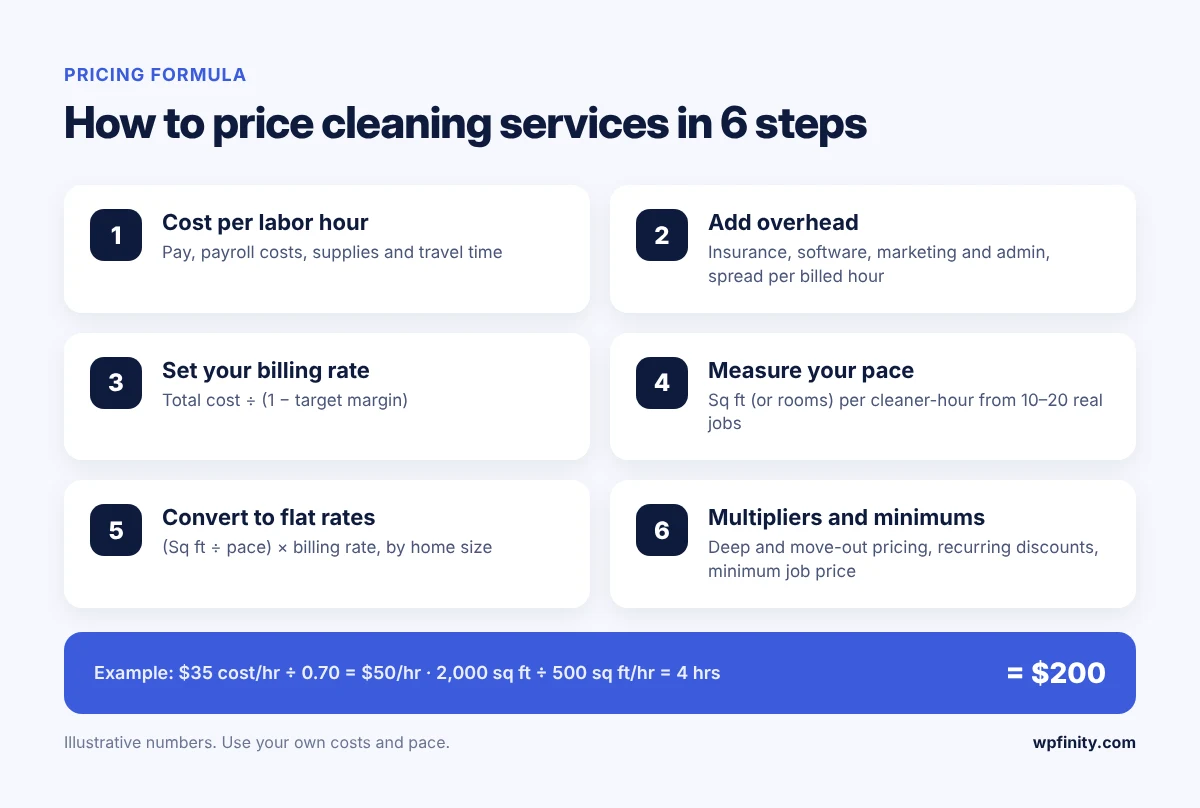
- Find your true cost per labor hour. Add the cleaner’s hourly pay, payroll taxes and workers’ comp, supplies, and travel time between jobs. For reference, the median wage for maids and housekeeping cleaners was $16.08 per hour in May 2023, according to the US Bureau of Labor Statistics; your local market and pay goals may be higher.
- Add overhead. Spread insurance, software, marketing, phone, vehicle and your own admin time across the hours your team bills each month.
- Set your target margin and billing rate. Divide your total cost per hour by (1 minus your target margin). For a 30% margin, divide by 0.70.
- Measure your cleaning pace. Look at your last 10–20 typical jobs and work out how many square feet (or rooms) one cleaner finishes per hour for a standard clean.
- Convert to flat rates. Price = (square feet / pace) x billing rate. Build a simple price table by home size or by bedrooms and bathrooms.
- Add multipliers, discounts and a minimum. Deep and move-in/out cleans take longer, so price them higher; offer a small discount for weekly or biweekly plans; and set a minimum job price so short jobs still cover travel.
Worked example: pricing a 2,000 sq ft home
Say your cleaner earns $20 per hour, payroll costs add about $3, supplies and travel add $4, and overhead works out to $8 per billed hour. Your cost is $35 per labor hour. With a 30% margin, your billing rate is $35 / 0.70 = $50 per hour.
If one cleaner covers about 500 sq ft per hour on a standard clean, a 2,000 sq ft home takes 4 cleaner-hours: 4 x $50 = $200 for a standard clean. Two cleaners finish in about 2 hours on site, and the price stays the same. A deep clean at 1.5x the time comes to $300.
Those numbers sit inside the market ranges Housecall Pro reports for a 2,000 sq ft home ($200–$400 standard, $240–$600 deep), which is a good sanity check. If your formula lands far outside the local range, recheck your pace and costs before you change the price.
Get early access to Cleannetic
Want a booking form that shows customers a price for every service you offer? Join the Cleannetic waitlist and get an early-access invite when the plugin launches.
How should you price specialty cleaning services?
Specialty cleaning services are easiest to price by the unit the customer can count: windows, rooms of carpet, square feet of driveway or truckload volume. Using the right unit lets a customer get a fair price online without a site visit.
| Service type | Common pricing unit | Questions to ask before quoting |
|---|---|---|
| Residential (standard) | Flat rate by bedrooms/bathrooms or sq ft | Pets, condition, frequency |
| Deep cleaning | Standard price x multiplier | Last professional clean, build-up, appliances inside |
| Move-in/move-out | Flat rate by size, often deep-clean level | Empty or furnished, inside cabinets, fridge and oven |
| Office/commercial | Per sq ft or monthly contract | Visits per week, restrooms, after-hours access |
| Window cleaning | Per window or per pane, plus minimum | Count, stories, screens, tracks, hard-water stains |
| Carpet cleaning | Per room or per sq ft | Number of rooms, stairs, stains, pet treatment |
| Pressure washing | Per sq ft of surface | Surface type (driveway, deck, siding), size, stains |
| Junk removal | By truckload volume (fraction of a load) | Item list or photos, stairs, heavy items |
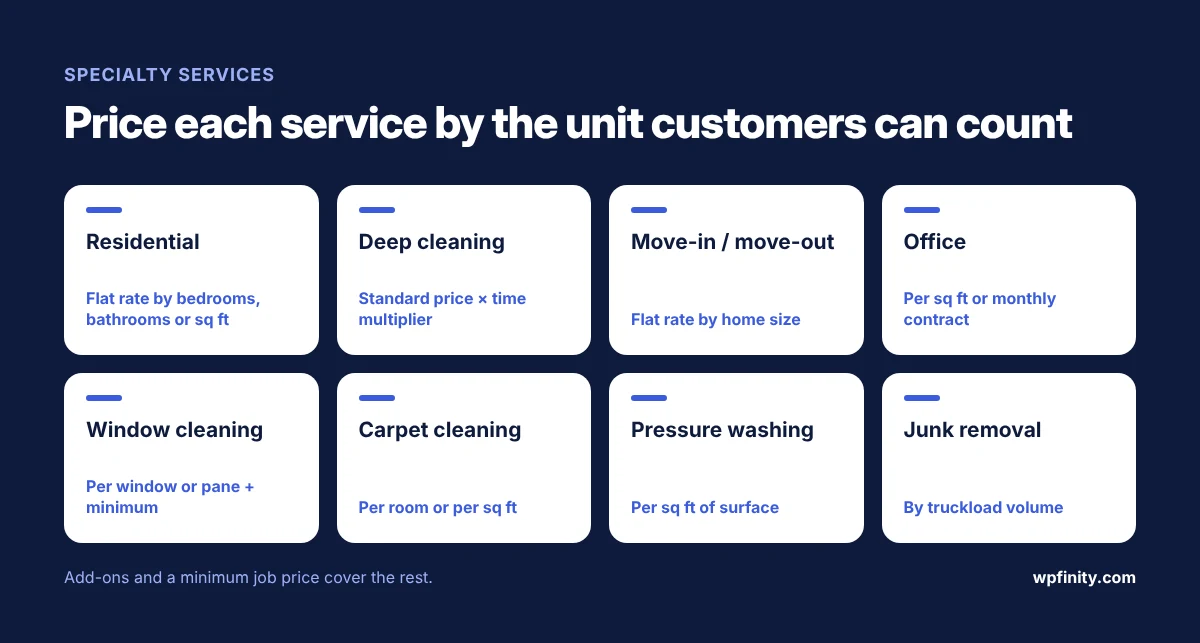
Window cleaning shows how unit pricing works in practice. Housecall Pro’s window cleaning pricing guide puts residential rates at $8–$16 per window for inside and outside, $4–$8 per pane, and a minimum service charge of $75–$250, with add-ons like screens and tracks priced separately. The same structure (unit price + add-ons + minimum) works for carpet, pressure washing and junk removal.
If you offer more than one service, keep each service’s pricing separate. A move-out clean, a carpet clean and a window job have different units and different questions, so they should not share one generic quote form.
How do you show cleaning prices on your website without losing jobs?
Show customers a real price, or at least a clear starting price, before they have to contact you. Visitors who see “Call for a quote” often move on to the next company in the search results, while a booking form that calculates the price as they answer questions captures the job while they’re ready to buy.
Practical ways to put your pricing online:
- Publish “from” prices for each service, such as “Standard clean from $150”, so people know you’re in their budget.
- Turn your pricing table into booking form questions. Bedrooms, bathrooms, square footage, frequency and add-ons should change the price automatically.
- Use quote requests only where you need them, such as commercial or post-construction jobs, and ask for photos up front.
- Take a deposit for larger jobs like move-out and deep cleans to reduce no-shows.
- Put your extra-time and cancellation rules next to the price, so there are no surprises on the day.
This is the problem Cleannetic is being built to solve. Cleannetic is an upcoming WordPress booking plugin from Wpfinity for cleaning companies, with support for residential, deep cleaning, move-in/out, office, window, pressure washing, carpet, junk removal and your own custom service types. Each service type can be set up the way you actually sell it. Cleannetic will be available as a free plugin on WordPress.org plus a pro version, and it’s launching soon.
If you’re setting up booking for the first time, start with our guide to online booking for cleaning businesses, which covers intake questions, deposits and reminders.
What are the most common cleaning pricing mistakes?
The most common cleaning pricing mistake is copying a competitor’s prices without knowing your own cost per hour. Their costs, pay rates and pace are not yours, so their price can lose you money.
Other mistakes to avoid:
- Forgetting travel time. Drive time between jobs is paid time. Build it into your cost per hour or set a minimum job price.
- No minimum charge. A $60 bathroom-only job across town can cost more than it earns.
- Pricing deep cleans like standard cleans. First-time and move-out cleans can take far longer. Price them as a separate service.
- Never raising prices. Review your numbers at least once a year and give recurring customers notice before an increase.
- Hiding prices completely. Customers comparing companies online want a number. Give a range or a starting price at minimum.
FAQ
How much should I charge for house cleaning?
Build your price from your own cost per labor hour plus a profit margin, then check it against local rates. For context, Housecall Pro’s 2026 guide reports US house cleaners typically charge $30–$80 per hour per cleaner, and $200–$400 for a standard clean of a 2,000 sq ft home.
Is it better to charge hourly or a flat rate for cleaning?
A flat rate is usually better for recurring residential cleaning because customers know the total before they book and efficient crews keep the time they save. Hourly pricing works best when the scope is unclear, such as organizing or heavy first-time cleans.
How do you calculate a cleaning price per square foot?
Divide your billing rate by your cleaning pace. If you bill $50 per hour and one cleaner covers 500 sq ft per hour, your rate is $0.10 per sq ft, so a 2,000 sq ft home is $200 for a standard clean.
How much more should a deep clean cost than a standard clean?
Price a deep clean by the extra time it takes, often 1.5 to 2 times a standard clean. Housecall Pro, citing Angi’s 2026 data, notes a 4-bedroom deep clean can run up to twice the standard price.
Should I offer discounts for recurring cleaning?
Yes, a small discount for weekly or biweekly service rewards loyalty and fills your schedule with predictable work. Keep it modest so the recurring price still covers your costs and margin.
Should cleaning companies show prices on their website?
Yes. Showing a starting price or letting customers calculate a price on your booking form helps visitors decide without calling, and keeps them from leaving to check a competitor. Use quote requests only for jobs you truly can’t price online.
How often should a cleaning business raise its prices?
Review your pricing at least once a year, or sooner if wages, fuel or supply costs rise. Give recurring customers written notice before a price increase takes effect.
Be first to try Cleannetic
Cleannetic, the WordPress booking plugin for cleaning companies, is launching soon as a free plugin on WordPress.org with a pro version. Join the waitlist for an early-access invite and launch updates.

 Cleaning Business
November 12, 2026
How to Bid Commercial Cleaning Jobs: A Step-by-Step Guide
Learn how to bid commercial cleaning jobs step by step: walkthrough, production rates, labor, overhead and profit, plus a worked…
Read more
 Cleaning Business
November 10, 2026
How to Price Carpet Cleaning: Per Room vs Per Square Foot
Learn how to price carpet cleaning per room or per square foot, with 2026 US price benchmarks, job minimums and…
Read more
 Cleaning Business
October 29, 2026
Cleaning Service Deposits: How Much to Charge and When
Should your cleaning business take a deposit? See how much to charge by service type, deposit vs card on file,…
Read more
Get new articles & release notes in your inbox
Sign up for updates on our upcoming releases. No spam — unsubscribe anytime.

6 Responses