Cleaning Service Deposits: How Much to Charge and When
Should your cleaning business take a deposit? See how much to charge by service type, deposit vs card on file, and how to collect it at online booking.

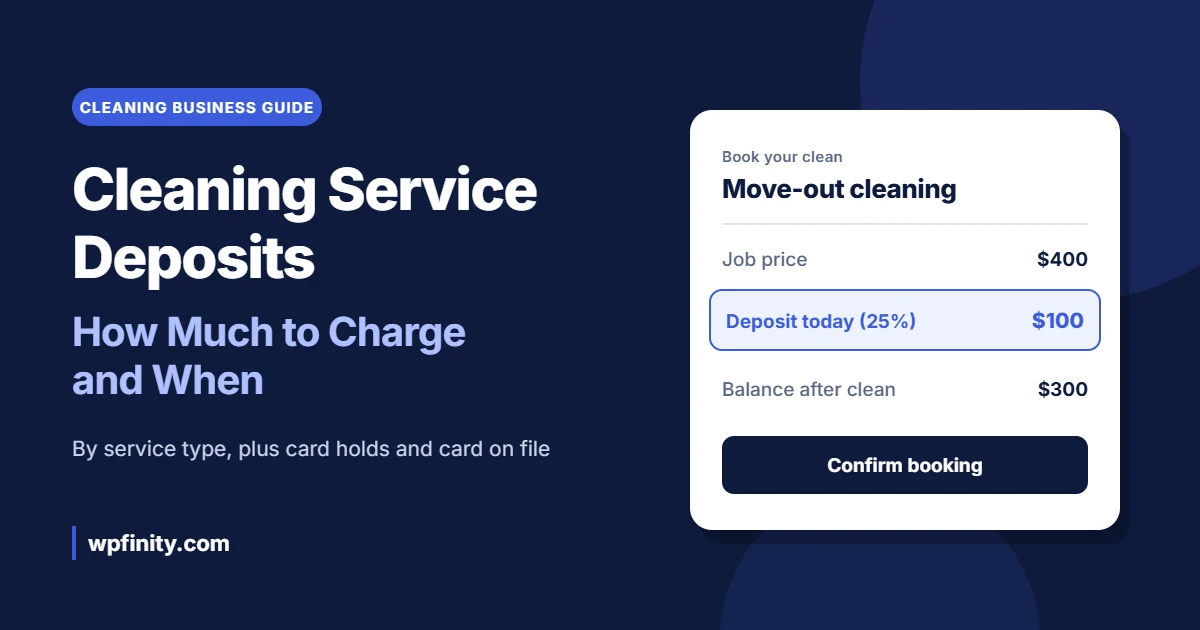
Short answer: A cleaning service deposit is a part-payment a customer makes when they book, usually 10–50% of the job price. Take one for new customers and big one-time jobs like deep cleans, move-outs and junk removal, and keep recurring clients on a card on file instead. Collect it on your online booking form so the job is secured the moment it’s booked.
Every cleaning business owner knows the feeling: the crew drives 25 minutes, nobody answers the door, and a half-day slot you turned other customers away for is gone. A deposit won’t stop every cancellation, but it filters out casual bookings and pays you for the time you held. This guide covers when to ask for one, how much to charge per service type, and how to collect it online without scaring customers off.
Should a cleaning business take a deposit?
Yes, for jobs where a cancellation would cost you money: first-time customers, large one-time jobs and date-critical work. Regular recurring clients usually don’t need one, because you already know them and can charge a saved card after each visit.
Housecall Pro’s guide to collecting cleaning payments recommends deposits for larger one-time jobs like move-out and deep cleans, collected at booking with the balance due once the job is done. In practice, a deposit makes sense when:
- The customer is new and you have no payment history with them
- The job blocks a half day or more of crew time
- The date is fixed and hard to refill, such as a move-out before a lease ends
- You pay costs upfront, like dump fees for junk removal or equipment rental
- The booking came in online from someone you’ve never spoken to
How much should a cleaning service deposit be?
Most service businesses ask for 10–50% of the job price, scaled to the size of the job. Housecall Pro’s deposit guide suggests 10–25% for smaller or repeat jobs, 20–33% for mid-sized projects and up to 50% for large jobs with a heavy labor commitment.
Here’s how those ranges map onto common cleaning services. Treat them as starting points and adjust for your market:
| Service type | Suggested deposit | Why |
|---|---|---|
| Recurring residential (weekly, biweekly) | None; card on file | Charge after each visit instead |
| First-time standard clean | 15–25% | Filters out no-shows from new customers |
| Deep cleaning | 25% | Longer job, more crew time held |
| Move-in / move-out | 25–50% | Fixed date, hard to refill if cancelled |
| Carpet, window, pressure washing (one-off) | 20–25% | Equipment and travel committed |
| Junk removal (large loads) | 25–50% | Covers disposal and truck costs |
| Office and commercial contracts | Usually none | Use invoice terms in the contract |
Always say whether the deposit counts toward the final bill. It almost always should; customers read a deposit that’s added on top as an extra fee. If you’re still setting your base prices, start with our guide on how to price cleaning services.
Deposit, card hold, card on file or full prepayment: which should you use?
Use a deposit for one-time jobs booked more than a week ahead, a card on file for recurring clients, and full prepayment for small fixed-price jobs. A card hold only works for jobs within a few days, because online card authorizations expire quickly.
The graphic below compares the four options side by side:
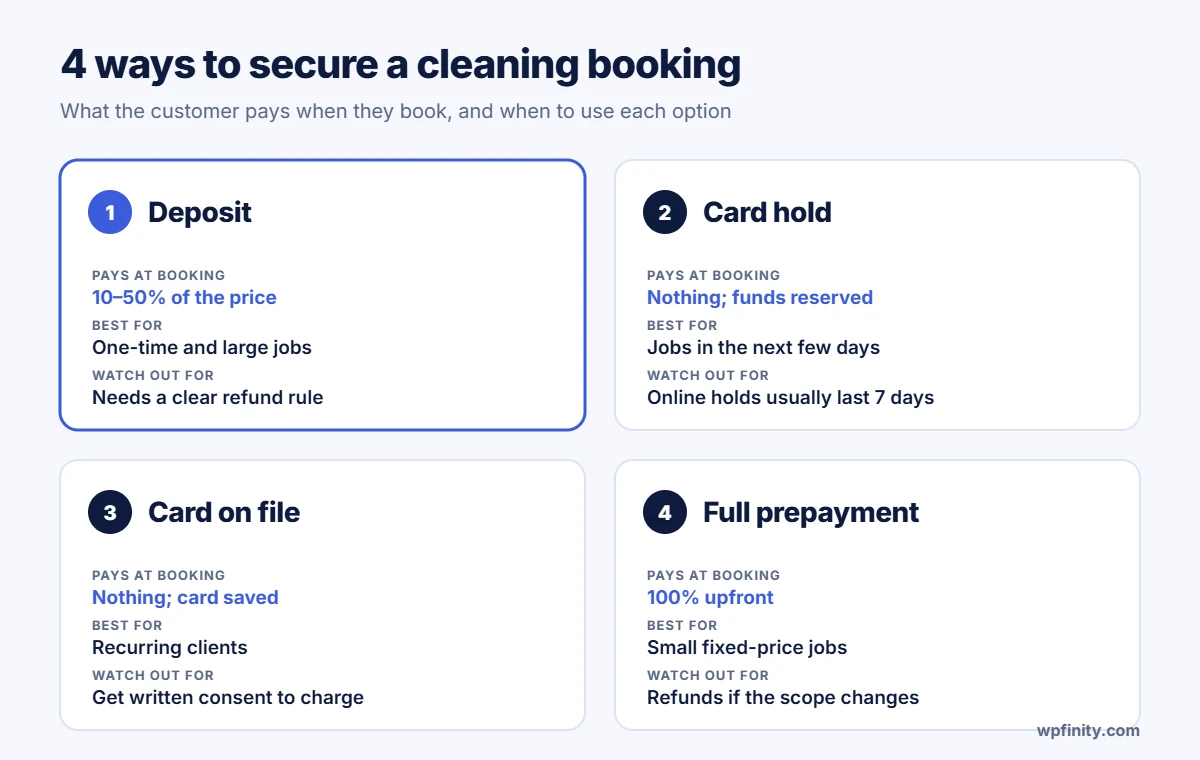
| Option | Customer pays at booking | Best for | Watch out for |
|---|---|---|---|
| Deposit | 10–50% of the price | One-time and large jobs | Needs a clear refund rule |
| Card hold | Nothing; funds reserved | Jobs in the next few days | Online holds usually last 7 days |
| Card on file | Nothing; card saved | Recurring clients | Get written consent to charge |
| Full prepayment | 100% | Small fixed-price jobs | Refunds if the scope changes |
The card hold limit matters more than most owners realize. Stripe’s documentation explains that an authorization for an online card payment is usually valid for 7 days, after which the funds are released. A hold placed for a move-out clean three weeks away would expire before the job.
Taking cleaning bookings on WordPress?
Cleannetic is Wpfinity’s upcoming booking plugin for cleaning companies. Join the waitlist for an early-access invite and launch updates.
How do you collect a cleaning deposit with online booking?
Make the deposit a required step in your booking form, shown with the price and refund rules before the customer pays. Then the booking and the payment happen together, with no follow-up calls or invoices to chase.
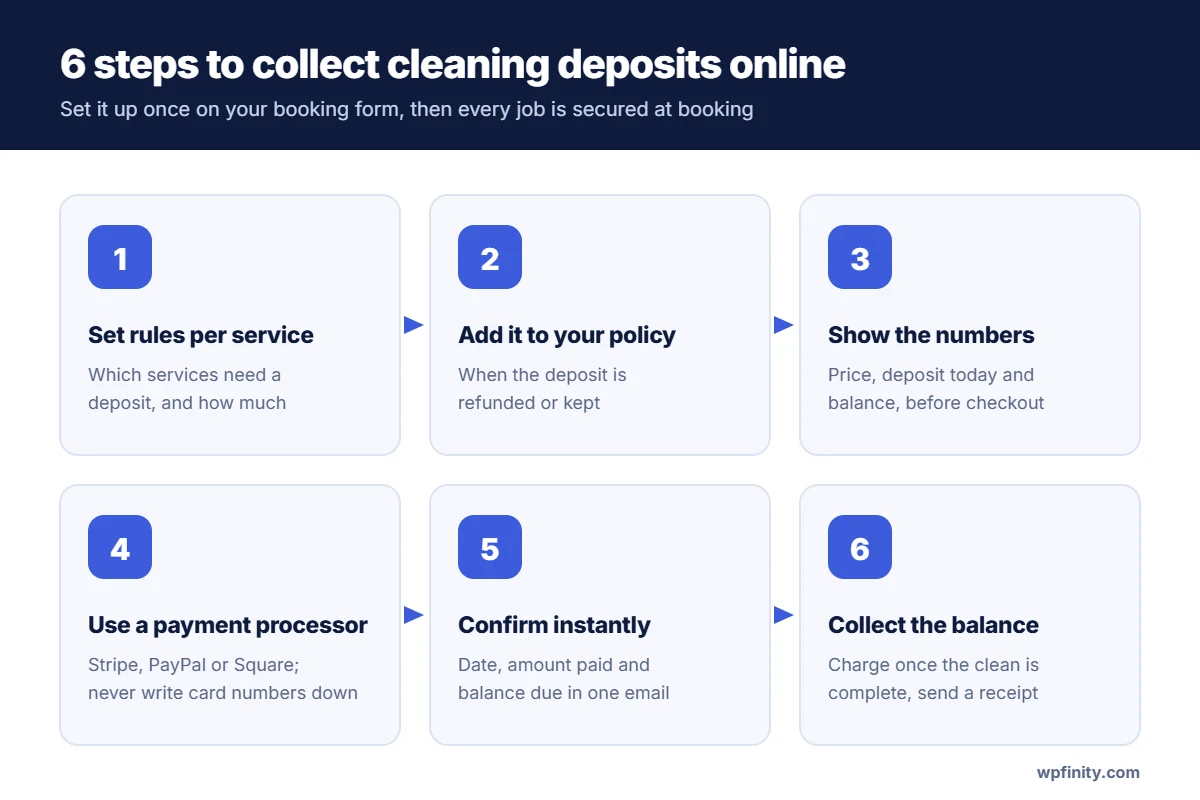
Set it up in six steps:
- Set rules per service type. Decide which services need a deposit and how much, using the table above.
- Put it in your cancellation policy. State when the deposit is refundable, when it’s kept and how rescheduling works. Our cleaning business cancellation policy guide includes a template you can adapt.
- Show the numbers before checkout. Display the job price, the deposit due today and the balance due after the clean.
- Take payment through a processor. Use a provider such as Stripe, PayPal or Square, and never write card numbers down. The PCI Security Standards Council’s guide for small merchants puts it plainly: “If you don’t need card data, don’t store it.”
- Confirm instantly. The confirmation email should show the date, the amount paid and the balance due.
- Collect the balance after the job. Charge it once the clean is marked complete and send a receipt the same day.
Leave some flexibility for the balance. In the Federal Reserve’s 2024 Consumer Payments Study, 70% of US consumers used credit cards and 67% used debit cards in the past year, but 78% still used cash. Take the deposit by card online, and accept the balance however your customer prefers.
If you’re building the rest of your booking flow, our setup guide for online booking walks through service menus, time slots and confirmations.
What should your deposit policy say?
A good deposit policy fits in four sentences: the amount, whether it’s applied to the final bill, when it’s refunded and what happens on a lockout. Put it on your booking form and in your confirmation email.
Here’s sample wording you can adapt:
A deposit of 25% is required to confirm your booking and is applied to your final bill. Cancel or reschedule at least 48 hours before your appointment for a full refund of your deposit. Cancellations within 48 hours, or appointments where our team can’t get in, keep the deposit to cover the time reserved. The balance is due once the cleaning is complete.
Keep the tone factual, not defensive. Most customers accept a deposit when it’s explained upfront as a way to hold their slot; it’s a surprise charge at checkout that causes complaints.
Can a WordPress site take cleaning deposits?
Yes. A WordPress booking plugin can show your services, calculate the price and take payment in the same form, so your website does the admin work. If you’re comparing options, see Cleaning Booking Software vs a WordPress Plugin.
Cleannetic is Wpfinity’s upcoming WordPress booking plugin for cleaning companies. It’s built for residential, deep cleaning, move-in/out, office, window, pressure washing, carpet and junk removal bookings, plus custom service types, so one booking form can cover every service you offer. It will launch soon as a free plugin on WordPress.org, with a pro version.
Cleaning service deposit FAQ
Is a cleaning deposit refundable?
It depends on your policy. Most cleaning businesses refund the deposit if the customer cancels or reschedules with enough notice, often 24 to 48 hours, and keep it for late cancellations and lockouts.
How much deposit should I take for a move-out clean?
A 25% to 50% deposit suits move-in and move-out cleans, because the date is fixed and a cancelled slot is hard to refill. Apply the deposit to the final bill.
Should I charge a deposit for recurring cleaning?
Usually not. Save the client’s card with their consent and charge after each visit. A deposit makes more sense for the first clean or for one-time jobs.
Does a deposit reduce no-shows?
A deposit gives customers a reason to show up or cancel in time, and it pays you for the slot if they don’t. It works best alongside reminders and a clear cancellation policy.
Can I hold a customer’s card instead of taking a deposit?
Yes, for jobs in the next few days. Online card holds usually expire after about 7 days, so use a deposit or a saved card for jobs booked further ahead.
Will Cleannetic work for cleaning businesses that take deposits?
Cleannetic is a WordPress booking plugin built for cleaning companies, launching soon as a free plugin with a pro version. Join the waitlist for an early-access invite and launch updates on what each version includes.
Get early access to Cleannetic
Cleannetic is launching soon, free on WordPress.org with a pro version. Sign up for an early-access invite and launch updates, and be among the first to take cleaning bookings on your own site.

 Cleaning Business
November 12, 2026
How to Bid Commercial Cleaning Jobs: A Step-by-Step Guide
Learn how to bid commercial cleaning jobs step by step: walkthrough, production rates, labor, overhead and profit, plus a worked…
Read more
 Cleaning Business
November 10, 2026
How to Price Carpet Cleaning: Per Room vs Per Square Foot
Learn how to price carpet cleaning per room or per square foot, with 2026 US price benchmarks, job minimums and…
Read more
 Cleaning Business
October 26, 2026
How to Price Window Cleaning Jobs: Per Pane, Per Window or Hourly
Learn how to price window cleaning per pane, per window or by the hour, set a minimum and add-ons, and…
Read more
Get new articles & release notes in your inbox
Sign up for updates on our upcoming releases. No spam — unsubscribe anytime.